Exoplanet Discovery
Exoplanet Discovery
Discover how space telescopes detect worlds beyond our solar system using ingenious detection methods.
Transit Method
The most successful exoplanet detection technique. When a planet passes in front of its host star, it blocks a tiny fraction of the star's light, creating a characteristic dip in brightness.
Transit Sequence
Before
Full brightness
During
Dip in light
After
Full brightness
Typical Light Dip
Hot Jupiter
~1%
Earth-sized
~0.008%
Simulated Transit Light Curve
Loading chart...
Radial Velocity (Doppler Wobble)
A planet's gravity causes its star to “wobble” slightly. By measuring the Doppler shift in the star's spectral lines, astronomers can determine the planet's minimum mass and orbital period.
How The Wobble Works
Detection Precision
Modern spectrographs like HARPS can detect stellar wobbles as small as 1 m/s — walking speed! This enables detection of Earth-mass planets around nearby stars.
Simulated Radial Velocity Curve
Loading chart...
Notable Discovered Exoplanets
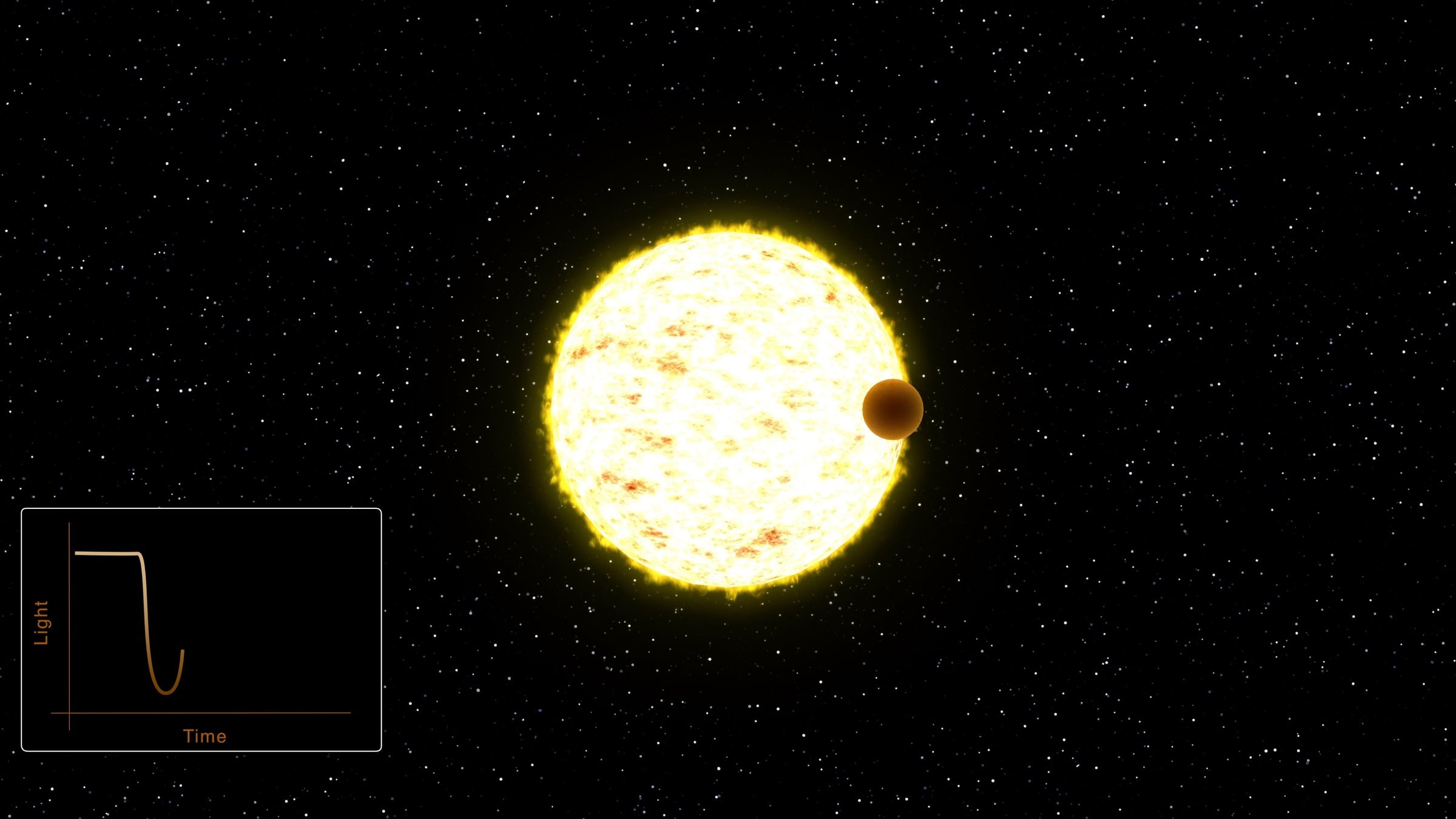
Artist's impression of an exoplanet transit
TRAPPIST-1e
Telescope
Spitzer
Size
0.91 Earth radii
Distance
40.7 ly
Special Feature
Earth-sized, in habitable zone of ultracool dwarf star
Kepler-186f
Telescope
Kepler
Size
1.17 Earth radii
Distance
~500 ly
Special Feature
First Earth-sized planet found in a habitable zone
WASP-12b
Telescope
SuperWASP
Size
1.9 Jupiter radii
Distance
~1,400 ly
Special Feature
Hot Jupiter being torn apart by its star
51 Pegasi b
Telescope
ELODIE
Size
1.27 Jupiter radii
Distance
~50 ly
Special Feature
First exoplanet found orbiting a Sun-like star
Proxima Centauri b
Telescope
HARPS
Size
~1.1 Earth radii
Distance
4.2 ly
Special Feature
Closest known exoplanet to Earth